BLOGGER TEMPLATES AND TWITTER BACKGROUNDS »

Monday, May 7, 2012

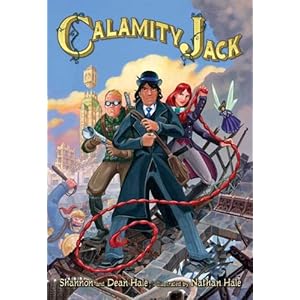
Calamity Jack


 Bibliography

Hale, Shannon, and Dean Hale. 2010. Ill. by Nathan Hale. Calamity Jack. New York: Bloomsbury. ISBN 9781599900766


Plot Summary
Calamity Jack is the exciting and fantastical story of Jack, a criminal mastermind.  When Jack discovers that his mother is being forced to make free bread for the giant, Blunderboar, he decides to teach the giant a lesson by stealing some of his valuables.  Jack uses a magic beanstalk to reach Blunderboar’s floating fortress, but when the beanstalk grows too big, Jack must make a quick getaway. Jack later returns to Shyport and realizes that Blunderboar has taken over the whole town and is holding his mother captive.  Jack, aided by a quirky band of friends, quickly formulates a plan to save his mother and get rid of Blunderboar forever. Calamity Jack is a unique take on the classic Jack and the Beanstalk tale.

Critical analysis
Shannon and Dean Hale have created a unique and exciting story in the graphic novel, Calamity Jack. Readers follow along as Jack, Rapunzel, and a couple of other loyal friends embark on an exciting journey to save Jack’s mother and their town. The story is full of fantasy and action with just a touch of romance.
Readers will root for Jack and Rapunzel as they struggle to defeat the giant, Blunderboar, and his league of minions. Jack admits that he is not perfect, but his desire to change makes him a likeable character. Jack's longing for approval and acceptance from his mother and Rapunzel will resonate with anyone that has ever sought forgiveness for poor choices. Rapunzel is a refreshing depiction of a strong female heroin. The Hales present Rapunzel as Jack’s equal and avoid the stereotypical “damsel in distress” scenario, thus creating an appealing story for both boys and girls alike.
The Hales’ combination of larger-than-life characters with the urban, old west creates a thrilling fantasy world. The authors’ use of onomatopoeia brings the text to life and adds excitement to the story. Calamity Jack contains minimal text, so most teens will have little trouble reading the story. Terms and phrases associated with the time period pepper the dialogue, adding authenticity to the story.
Nathan Hale does a brilliant job bringing the fantasy world of Shyport to life. He combines images associated with the old west, like period clothing, buildings, trains, and dirt roads with fantasy elements, like floating skyscrapers and giant creatures. Hale’s illustrations are vivid and detailed and are critical to the story.
Calamity Jack is based on the classic theme of good triumphing over evil. Although Jack was at once a thief, he attempts to mend his ways and save his mother and city from the giant. Despite Jack’s flaws, he is still the “good guy,” so readers can’t help but cheer for him as he defeats the evil Blunderboar in this exciting twist on Jack and the Beanstalk.

Awards


*YALSA’s Great Graphic Novels for Teens, 2011


Reviews

Booklist, 2009: “Shannon and Dean Hale have done an excellent job stretching the bones of the traditional fable into a high-action coming-of-age story that will keep young teen readers excited and engaged.”

Kirkus Reviews, 2009: Readers will relish this gleeful mix of fairy tale, adventure and romance.’”

VOYA, 2009: Nathan Hale (no relation) continues to draw in a clear and energetic style equally suited to the steampunk city as to the Wild West. Fans of the previous book will be happy to see this new installment, which should handily garner new fans as well.”

Connections

* Share Rapunzel’s Revenge by Shannon and Dean Hale.

*Ask students to write a short essay about what they think happens to Jack and Rapunzel after they return to Shyport.

*Ask students to share some ideas for other modern or unique versions of classic stories.
Friday, May 4, 2012

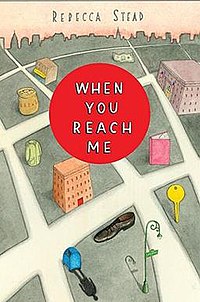
When You Reach Me


Bibliography

Stead, Rebecca. 2009. When You Reach Me. New York: Wendy Lamb Books. ISBN 9780385737425


Plot Summary

When Miranda receives a mysterious letter that says “I am coming to save your friend’s life, and my own,” she is alarmed and intrigued. At the request of the letter writer, Miranda writes her own letter, detailing the events of the last few months. As events unfold, Miranda pieces together the mystery and discovers that the future offers fantastic possibilities, including time travel.


Critical Analysis


In When Your Reach Me, Rebecca Stead flawlessly combines mystery and fantasy with typical childhood experiences, thus creating a unique and intriguing story of self-sacrifice. When Miranda begins to receive a series of mysterious letters and clues about the future, she starts to examine everything around her in hopes that something will reveal the identity of the letter writer. Although Miranda isn’t sure why, she suspects that the homeless man outside of her apartment building, whom she calls “the laughing man,” is an important clue to the mystery. What's more, she senses that her discussions about time travel with a boy named Marcus are also significant. Miranda finds the idea of time travel hard to believe, but in the end she discovers that anything is possible.


Stead has created a savvy and likeable character in twelve-year-old Miranda. Miranda's loyalty to her mother and friends is endearing. Children will relate to her curiosity and desire to solve the mystery as well as her longing to forge lasting friendships. Miranda’s disbelief in time travel will resonate with children that are skeptical of such fantastical ideas and makes her a more credible character.


When You Reach me is a contemporary story with a fantasy twist. Stead does not create a fantasy world, but rather inserts fantastical elements into a realistic world. Children will easily understand and relate to the characters and their urban setting. The story is told through first-person narrative, as Miranda writes the letter. In her writings, she recounts all of the events that have led up to the present. She details how she eventually unraveled the mystery and learned of Marcus’ ability to travel through time.


Miranda’s neighborhood is integral to the plot because that is where the most critical events in the story take place. Stead does an excellent job of transporting readers to 1970's Manhattan. Her references to décor, fashion, and various locations help readers visualize the setting and lend credibility to the story. Stead also introduces readers to 70’s popular culture as Miranda’s mom practices for the game show The $20,000 Pyramid.

When You Reach Me is an intriguing story that begs to be read over and over. Although younger readers may be confused by some of the dialogue pertaining to time travel, Stead ties up any loose ends in the final chapters of the book. Stead does not go into great detail about how time travel is possible, she merely acknowledges that it is possible. Although the science behind time travel leaves some questions, Stead still manages to provide a thoroughly satisfying ending.


Awards

*Boston Globe-Horn Book Award for Excellence in Children’s Literature: Winner, 2010

*John Newbery Medal: Winner, 2010

*Parent’s Choice Award, 2009


Reviews

Booklist Starred Review, 2009: “The ’70s New York setting is an honest reverberation of the era; the mental gymnastics required of readers are invigorating; and the characters, children and adults, are honest bits of humanity no matter in what place or time their souls rest. Just as Miranda rereads L’Engle, children will return to this.”

Kirkus Reviews, 2009: Some might guess at the baffling, heart-pounding conclusion, but when all the sidewalk characters from Miranda's Manhattan world converge amid mind-blowing revelations and cunning details, teen readers will circle back to the beginning and say, ‘Wow...cool.’”


Library Media Connection, 2009: The author’s style is appealing because of her character development and clever plot vehicles. The topics are interesting and the short chapters keep the pace flowing quickly. Recommended.”

Connections


¬  Read A Wrinkle in Time by Madeleine l’ Engle, then discuss the similarities and differences between the two stories.

¬  Ask student to write an essay about a moment in time they would revisit and what, if anything, they would change or do differently.

¬  If possible, share some clips of The $20,000 Pyramid and then divide children up into pairs to play the game.

¬  Share other books by Rebecca Stead, including: First Light and Liar & Spy

Thursday, May 3, 2012

Speak


Bibliography

Anderson, Laurie Halse, and Mandy Siegfried. 2004. Speak. New York: Random House/Listening Library.ISBN 9781400089987

Plot Summary

A traumatic event at a summer party changes Melinda Sordino’s life forever.  She begins high school without any friends or sense of purpose, so she isolates herself and rarely speaks to anyone. As Melinda struggles to complete a semester-long art project, she comes to terms with what happened to her and eventually finds her voice. In this dark, yet inspiring story, Laurie Halse Anderson weaves a mysterious and inspiring tale about finding inner strength among the pressures of high school.

Critical Analysis

In Anderson’s debut novel, she brilliantly captures the struggles of dealing with trauma and the insecurities of adolescence.  As Melinda begins her freshman year of high school, she desperately tries to forget about being raped at a summer party. Feeling alone, Melinda closes herself off from the people around her, she worries that no one will understand or believe her. The more Melinda isolates herself, the less she is able to "speak."

Speak is written in first-person narrative, so readers are able to connect with Melinda and see the world through her eyes. At the beginning of the story, Melinda describes how all of her friends have stopped talking to her after she called the cops to the party. Over the course of the school year, Melinda recalls the events of that night and ultimately comes to terms with what happened. Anderson creates mystery and excitement in the story by slowly releasing the details about Melinda’s traumatic event.

 Although the subject matter is dark, Anderson flawlessly integrates humor into the story with Melinda’s sarcastic view of teenage life. Readers will relate to Melinda’s struggle with friends, parents, teachers, and school. Her references to the coach/teacher dubbed “Mr. Neck” will resonate with readers that have had comparable teachers. Melinda’s observations of her parents, and their seemingly unhappy marriage, will also feel familiar to some readers. Although the character Andy Evans is rather unsavory, Anderson does not bog down the story with moral judgments or stereotypes. Melinda is comforted by her unconventional art teacher, Mr. Freeman, and fellow student, David Petrakis. As Melinda struggles to find her voice, she transitions from a desperate and broken character into one that is more empowered and confident .

Anderson does a fine job of describing Syracuse, New York and Melinda’s surroundings, yet she does not get caught up in the details. Readers from various parts of the world are able to visualize and relate to the story because it has an “any town” feel. Anderson’s use of dialogue is relevant and universal. Readers now and in the future will relate to the characters because the story is not associated with any specific time period. 

About the Audiobook

Speak is an engrossing story and the audiobook version will keep listeners interested until the very end. Mandy Siegfried does an exceptional job narrating the fairly short (5 hour) story. The sincerity and emotion in Siegfried’s voice provides a credible portrayal of Melinda. Listeners are able to visualize Melinda’s fear, sadness, and insecurities in Siegfried’s performance.

Awards

¬  Michael L. Printz Award:  Honor Book, 2000

¬  Golden Kite Award, 2000

¬  Los Angeles Time Book Prize: Finalist, 1999

Reviews

Booklist, 1999: “In her YA fiction debut, Anderson perfectly captures the harsh conformity of high-school cliques and one teen's struggle to find acceptance from her peers.”

Kirkus Reviews, 1999:The plot is gripping and the characters are powerfully drawn, but it is its raw and unvarnished look at the dynamics of the high school experience that makes this a novel that will be hard for readers to forget.”

The ALAN Review, Winter 2000:The wonderfully descriptive language, along with the suspense, capture and propel the reader through this tale.”

Connections

*Discuss post-traumatic stress disorder. Pass out a list of non-fiction books about rape and post-traumatic stress disorder. Include information for rape hotlines. Some book titles include:

·        Frequently Asked Questions About Date Rape by Tamra Orr

·        Recovering From Rape by Linda E. Ledray

·        Real Girl/Real World: Tools for Finding Your True Self by Heather M. Gray

·        Post-Traumatic Stress by Carrie Fredericks

*Ask students to draw a tree that is representative of their life and/or the way they feel.

*Ask students to write a brief summary of the book and what advice they would give to Melinda.

Sunday, April 22, 2012

Catherine, Called Birdy

BIBLIOGRAPHY
            Cushman, Karen. 1994. Catherine, Called Birdy. New York: Clarion Books. ISBN 0395681863

PLOT SUMMARY
In Catherine, Called Birdy, Karen Cushman has created a witty and fascinating story about medieval life. The story is told through the fictional diary of Catherine, a 14-year-old, English noble. As common in medieval society, Catherine is expected to marry a man of her father’s choosing; however, Catherine longs for independence and makes every attempt to foil any plans for a betrothal. Despite her best efforts, Catherine soon learns that she must marry a repulsive baron, whom she calls Shaggy Beard. After her many attempts to rebuff Shaggy Beard, Catherine realizes that she must make compromises in order to find happiness.


CRITICAL ANALYSIS

This is a fascinating story of life during the 13th century. The realities of the time period are not glamorized or subdued, but are presented with honesty and authenticity. The filthy conditions and sickness that are indicative of medieval times is accurately depicted in the story, which helps readers to gain a clear understanding of life during the middle ages. 

Since the book is written in diary format, Catherine is the only well developed character. However, readers will easily identify with the witty and strong-willed Catherine, who longs for a different life. Catherine’s longing for independence is a universal theme, which will resonate with many of today’s young readers. The story encourages readers to think about societal norms and breaking with tradition. The book also illustrates how far women have come in society.

Cushman’s use of authentic language lends credibility to the story’s historical accuracy. Terms like privy, spinning, and chamber capture the essence of the 13th century. Cushman also makes the setting an integral part of the story. Descriptions of the manor, cottages, village, and style of dress paint a vivid portrait of medieval life and further contribute to the authenticity of the story.  Overall, Cushman has brilliantly woven together fact and fiction, thus creating a story that is both easy and enjoyable to read.

Catherine, Called Birdy is a well-balanced story, which encourages further research. The information about saints and historical figures, like Eleanor of Aquitaine, provide great opportunities for discussion. In the author’s note, Cushman offers additional insight into medieval life along with recommendations for further reading. However, the book lacks a list of reference sources, so readers will have to conduct their own research to distinguish fact from fiction.


REVIEW EXCERPTS

KIRKUS REVIEWS, 1994: “The period has rarely been presented for young people with such authenticity; the exotic details will intrigue readers while they relate more closely to Birdy's yen for independence and her sensibilities toward the downtrodden.”

SCHOOL LIBRARY JOURNAL: “The book is rich with information about the food, dress, religious beliefs, manners, health, medical practices, and sanitary habits (or lack thereof) of the people of her day. From the number of fleas she kills in an evening to her herbal medicines laced with urine, Birdy reveals fascinating facts about her time period.”

BOOKLIST: “Birdy's is the only real voice. Fortunately, it's a sprightly voice, complete with its own brand of cursing ("God's thumbs!"), that moves the action. Kids can read this on their own or as a supplement to studies of the Middle Ages.”

AWARDS

*John Newbery Medal, 1995 Honor Book

*ABBY Award, 1996 Honor Book

*Parents’ Choice Award, 1994 Gold Fiction

CONNECTIONS

*Share other medieval historical fiction books, like:
  • The Midwife’s Apprentice by Karen Cushman
  • The Door in the Wall by Marguerite De Angeli
*Ask students to conduct research on one of the saints mentioned in the book and then write a short essay about the saint.

*Discuss how Catherine’s collection of birds is a metaphor for her own life.

*Discuss how the lives of women have changed over time. Do women still face any of the challenges that Catherine faced?

Saturday, April 21, 2012

The Green Glass Sea


BIBLIOGRAPHY
Klages, Ellen. 2006. The Green Glass Sea. New York: Viking. ISBN

 
0670061344


PLOT SUMMARY

The year is 1943 and Dewey Kerrigan is on her way to be reunited with her father. Dewey’s father is one of many scientists working on “the gadget,” a top secret military project in Los Alamos, New Mexico. Although Dewey does not know what “the gadget” is she knows that it is supposed to help the Americans win World War II. When Dewey arrives in Los Alamos, she finds herself at home on the military base dubbed “the Hill.” She dedicates most of her free time to working on her radio and other mechanical contraptions. When an unexpected tragedy changes Dewey’s life, she must come to grips with not only how the world is changing, but also her uncertain future.

CRITICAL ANALYSIS

The Green Glass Sea is a fascinating story about life on the Los Alamos military base during World War II. Due to the relative currency of the time period contemporary readers will have little trouble following the story. Klages provides a balanced combination of fact and fiction. She references various styles of dress, food, and technology consistent with the 1940s, thus creating an authentic and compelling story.

The story is told in alternating chapters, focusing on the two main characters, Dewey and Suze. Klages characterizations of Dewey and Suze are honest and compelling. Readers come to feel like they really know the two characters. The girls’ experiences in their time on “the Hill” reflect the attitudes and ideas during World War II, particularly in reference to winning the war.  Although most readers will not identify with living on a top secret military base, they will relate to the girls’ desire for acceptance and attention. 

The Green Glass Sea is arranged in alternating chapters about Dewy and Suze, respectively.  Dewey is an independent and savvy young girl, yet she is still fragile. As she puts on a brave front for her father and everyone else around her, Dewey longs for her father’s attention and a normal family life. When her father suddenly dies, Dewey is no longer able to maintain her brave façade. Conversely, Suze is an insecure, tough girl who longs for acceptance from her peers. Suze is reluctant to get to know the girl dubbed “Screwy Dewey,” but she soon learns that she has never had a better friend.

Klages vivid depiction of Los Alamos and “the Hill” provide an authentic representation of life on the military base during World War II. Dewey describes the desolate landscape of New Mexico and Los Alamos during her train ride to the military base. She often points out how there is nothing for miles and miles. “The Hill,” with its legion of guards and top secret buildings, is a critical component of the story. Dewey and Suze rarely leave the base, so the setting is conveyed in great detail, further adding to the story’s authenticity.

As the scientists on “the Hill” work tirelessly to perfect “the gadget” the powerful theme of war ethics emerges. Although the scientists are eager to win the war, the implications of their discoveries are not realized until the very end of the book. The Green Glass Sea provides an opportunity to discuss war, grief, and the ethical use of knowledge/power.

Klages does not provide a list of sources at the end of The Green Glass Sea, but she does acknowledge people and resources that she found helpful in researching the book. She also includes an author’s note and a list of recommended sources.

REVIEW EXCERPTS

VOYA, 2007: “The book is well written, with intelligent characters and understandable descriptions of the place and the work being accomplished. Its well-researched information, including the debate that occurred when the scientists realized what they had created, will appeal to readers of historical fiction.”

LIBRARY MEDIA CONNECTION, 2007: “The description of this part of World War II is interesting and provocative. This well-paced story gives us an insight to a different part of the war and how it affected the people that were involved in the Manhattan Project. Recommended.

BOOKLIST, 2006: “The novel occasionally gets mired down in detail, but the characters are exceptionally well drawn, and the compelling, unusual setting makes a great tie-in for history classes.”

AWARDS

*Scott O’Dell Award Winner, 2007

*Judy Lopez Award Winner, 2007


CONNECTIONS

*Share other books about the Manhattan Project, like:
·         The Secret of the Manhattan Project by Doreen Gonzales
·         The Ultimate Weapon: The Race to Develop the Atomic Bomb by Edward T. Sullivan
·         White Sands, Red Menace  by Ellen Klages

*Show students pictures of trinitite and visit the Trinity base website, so that students can see actual photographs of the blast site (http://www.wsmr.army.mil/PAO/Trinity/Pages/default.aspx).

*Divide students into two groups and have a debate about the use of the atomic bomb.

*Ask students to research a scientist that worked on the Manhattan Project and then write a short report about the scientist.

Friday, April 20, 2012

The Evolution of Calpurnia Tate

BIBLIOGRAPHY

Kelly, Jacqueline. 2009. The Evolution of Calpurnia Tate. New York: Henry Holt. ISBN 9780805088410

 PLOT SUMMARY

The Evolution of Calpurnia Tate is the story of a young girl's self discovery during the early 20th century. Calpurnia Virginia Tate, Callie Vee for short, is a spunky and curious eleven-year-old, who is a born scientist. One day, while sitting in her yard, Callie notices two different types of grasshoppers. She wonders why the green grasshoppers are little while the yellow grasshoppers are much bigger. In her quest for answers, Callie finds an unlikely companion in her cantankerous grandfather. Over the course of the next year Callie grows closer to her grandfather as he teaches her all about science. As Callie learns more about science her desire to become a scientist intensifies, much to the dismay of her conservative mother.

Through Callie's adventures, readers learn about various scientific facts, like evolution, the life cycle, and microscopic organisms, as well as events that had a great impact on society, like the invention of the telephone and automobile. Kelly has discovered a unique way to blend science, history, and fiction into an appealing and interesting story.

CRITICAL ANALYSIS

Jaqueline Kelly's story of a precocious young girl in 1899, Texas is the perfect blend of fact and fiction. Kelly flawlessly incorporates factual information about science and history into a beautiful story of hope and determination. Callie's story proceeds in chronological order over the course of a year. Each chapter of the book begins with an excerpt of Charles Darwin's The Origin of Species, which highlights a particular event in Callie's life.

Callie is full of charisma, so readers can't help but cheer for her as she longs to break away from the traditional expectations of young girls in the 20th century. Calpurnia's grandfather, whom she calls “granddaddy” starts off as a bit of a mysterious character, but as his relationship with Callie grows, readers discover his complexity and genuineness. Kelly does an excellent job describing all of the supporting characters in her book, readers come to know the whole Tate family.

Kelly flawlessly captures life in 1899, Texas. Her description of Fentress and the Tate's cotton and pecan farm provide a clear image of rural life during the early 20th century. Kelly's use of southern dialect and terms/phrases common in 1899 brilliantly capture the essence of the time period. Her description of horse-pulled gigs, the town's first telephone connection, and various social events transport readers back in time. The scientific terms and historical references throughout the book lend credibility and authenticity to the story.

As Callie struggles to follow her dreams, she is pressured by her mother to follow a more traditional path of sewing and cooking. The story's theme of following one's dreams is universal, so even today's youth can relate to Callie's desire to carve out her place in the world. The Evolution of Calpurnia Tate encourages discussion about the role of women during the early 20th century and the advantages of living in today's society.

Jacqueline Kelly does not provide a list of sources for the information included in the book. In the author's note, she mentions that not everything in the book is accurate, so readers must conduct their own research to distinguish fact from fiction. Kelly does include a list of possible discussion questions, which promote critical evaluation of the text.


REVIEW EXCERPTS


KIRKUS REVIEWS, 2009: “Readers will finish this witty, deftly crafted debut novel rooting for "Callie Vee" and wishing they knew what kind of adult she would become.”

LIBRARY MEDIA CONNECTION, 2009: “The references to the inventions that come about add charm to the story. Recommended.”

BOOKLIST, 2009: “Many readers will hope for a sequel to this engaging, satisfying first novel.”

AWARDS

*John Newbery Medal, 2010 Honor Book

*Josette Frank Award, 2010 Winner

CONNECTIONS
*Discuss Charles Darwin and share some books about his life and work, including:
  • The Origin of Species by Charles Darwin
  • DK Biography: Charles Darwin by David C. King
  • Charles Darwin by Kathleen Krull
*Ask students to conduct research on one of the scientific topics Callie mentions and then write a short essay about the topic.

*Ask students to discuss how the lives of women have changed since 1899. A good website for obtaining pictures and additional information about women's history is the National Women's History Museum (www.nwhm.org).