BIBLIOGRAPHY
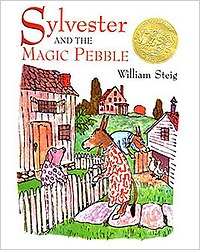
Steig, William. 1969. Sylvester and the Magic Pebble. Ill. by William Steig. New York: Windmill Books. ISBN 0671665111
PLOT SUMMARY
One day while searching for unusual pebbles on Strawberry Hill, Sylvester finds a bright, shiny, red pebble. Soon, he discovers that his treasured new pebble is magical and grants any wish he desires. On his way to share the good news with his family, Sylvester encounters a scary lion. Sylvester panics and wishes to become a rock and when the pebble drops to the ground he is unable to wish himself back to normal. As time passes, Sylvester gives up hope that he will ever be turned back into his old self.
CRITICAL ANALYSIS
Steig’s writing is descriptive and thorough, phrases like: “It was flaming red, shiny, and perfectly round, like a marble,” are used throughout the book. His use of imagery appeals to the senses and creates a visual for the reader. The book is written in chronological order, so the reader has a clear understanding of how events unfold. The passage of time is an important element in the book, which Steig handles flawlessly by detailing the changes in seasons.
Steig’s ink and watercolor illustrations create a dreamy effect and perfectly convey the emotions of the story. When the story first begins and Sylvester is happily searching for pebbles on Strawberry Hill, there are lots of bright, cheery colors. After Sylvester is turned into a rock, the colors and illustrations are more subdued and somber. Steig uses small bubble-like paintings on a white background, which makes the illustrations pop and draws in the reader’s eye. The text is written in the white space, so it does not compromise the effect of the illustrations.
The underlying theme of Sylvester and the Magic Pebble is that there is nothing more fulfilling than being with the ones you love. At first, Sylvester is elated to find the magic pebble, but after being separated from his parents he comes to realize that family is most important. This book provides a good opportunity for adults to discuss what happens when a child is missing. In the story, children witness the sadness and grief experienced by Sylvester and his parents, thus providing opportunities to discuss feelings.
REVIEW EXCERPTS
Ø PUBLISHER’S WEEKLY REVIEW: “This tale of a donkey who wishes on a magic pebble has charmed a generation of readers and will no doubt go on to attract a new one”.
Ø NEW YORK TIMES BOOK REVIEW: “Everything Mr. Steig does is magic”
AWARDS
Randolph Caldecott Medal: Winner, 1970
American Library Association (ALA) Notable Children’s Book
CONNECTIONS
* Pass out red pieces of paper shaped like pebbles and ask children to write what they would wish for if they had a magic pebble.
* Ask children to discuss what they think is most important.
* Discuss the seasons and passage of time. Ask children to create a visual timeline for the book.
* Play a version of freeze dance, where one child is selected as the lion and he/she gets to stop and start the music.
