BLOGGER TEMPLATES AND TWITTER BACKGROUNDS »

Sunday, April 8, 2012

What Do You Do With a Tail Like This?


BIBLIOGRAPHY

            Jenkins, Steve and Robin Page. 2003. What Do You Do With a Tail Like This?. Ill. by Steve Jenkins. Boston: Houghton Mifflin Company. ISBN 9780618800452

PLOT SUMMARY

What Do You Do With a Tail Like This? by Steve Jenkins and Robin Page is an entertaining and informative book about animals. The book is arranged in a way that creates suspense and excitement for the reader. Illustrations of various parts of an animal’s body, like feet, eyes, or ears are accompanied by a question, like “What do you do with eyes like these?” The reader then flips the page and sees a full size image of the animal accompanied by a quick fact about how the animal uses a particular part of his body. Jenkins and Page discuss 30 different animals, from scorpions to monkeys and how these animals use their body parts in unique ways. The question and answer format of this book will keep children interested until the very end and will likely stimulate a lively discussion about animals.

CRITICAL ANALYSIS

Steve Jenkins is an award-winning author of children’s non-fiction books. In What Do You Do With a Tail Like This? Jenkins and Page have created a fun and engaging concept book about animals. The book follows a clear pattern, which is a general question about an animal’s body part followed by a more specific answer about a particular animal. The short questions and the way that the illustrations are arranged will pique young children’s interest. Children will enjoy trying to guess which animal the body part belongs to and how the animal uses that particular part. 

Jenkins’ collage illustrations are vibrant, varied, and accurately depict the various animals in the story. Illustrations alternate between showing a portion of the animals’ body to revealing the whole animal with accompanying facts. The back of the book includes a detailed definition and description of the animals mentioned. 

Sharing What Do You Do With a Tail Like This? is a great way to introduce young children to informational books. The illustrations and minimal text help young children focus on the information presented and encourage curiosity and interaction. The facts and animal descriptions at the end of the book encourage further study about animals.


REVIEW EXCERPTS

THE BULLETIN OF THE CENTER FOR CHILDREN’S BOOKS: “With some kind of critter for everyone, this will be useful for entry-level natural history.”

LIBRARY MEDIA CONNECTION, 2004: “This wonderfully creative and well-designed book will be fun for early readers who enjoy animals.”

BOOKLIST, 2003: “This is a striking, thoughtfully created book with intriguing facts made more memorable through dynamic art.”

AWARDS

*Charlotte Zolotow Award, 2004
*Randolph Caldecott Medal, 2004 Honor Book

CONNECTIONS

*Discuss the information children found most surprising. Then have students nominate and vote for the animal they would like to learn more about. Create a follow up lesson about the chosen animal.

*Give the children art supplies and ask them to create a picture of their favorite animal from the story.

*Share other books by Steve Jenkins, like:
  • What Do You Do When Something Wants to Eat You?
  • Biggest, Strongest, Fastest
  • Never Smile at a Monkey: And 17 Other Important Things to Remember

Saturday, April 7, 2012

Bodies from the Ice: Melting Glaciers and the Recovery of the Past


BIBLIOGRAPHY

            Deem, James M.. 2008. Bodies from the Ice: Melting Glaciers and the Recovery of the Past. Boston: Houghton Mifflin Company. ISBN 9780618800452

PLOT SUMMARY

Bodies from the Ice: Melting Glaciers and the Recovery of the Past is a photo essay book by James M. Deem. Deem’s book details the numerous people and artifacts discovered after the melting of glaciers. The book opens with the discovery of Ötzi in 1991. Ötzi was a man that lived during the Copper Age and when his frozen remains were discovered in the Ötzal Alps, he was estimated to be about 5,300 years old. Actual photographs of the excavation site, Ötzi, and scientists provide an accurate and dramatic look at the historical finding. 

Deem goes on to provide details of numerous other archaeological discoveries due to melting glaciers. Some of the other discoveries include Incan children in the Andes Mountains and the body of famous mountain climber George Mallory on Mount Everest. Deem is quick to point out that although the melting of glaciers has uncovered interesting pieces of history, there may be dire consequences for the planet. He encourages readers to learn how to protect the environment and to visit a glacier while they still have to opportunity to see one.

CRITICAL ANALYSIS

Bodies from the Ice: Melting Glaciers and the Recovery of the Past is a fascinating book, which reveals Deem’s passion for glaciers and the history locked inside. In the book, Deem provides many interesting facts about glaciers, archaeology, and global warming. Readers will enjoy the variety of images as well as the supplemental facts and stories presented throughout the text. 

Deem’s use of photographs help the reader to understand the text and make the book accessible to readers of various ages. The large photographs, on every page, facilitate interest in the story and help to break up the text. The graphic photographs of Ötzi’s excavation will intrigue readers of all ages, especially those interested in science and history. Although the book is somewhat lengthy, the combination of text and photographs make this book an interesting and informative read.

Although users of all ages will enjoy looking at the book, it is best suited to older readers or in incremental portions. Deem has included a table of contents, index, and bibliography, which allows readers to use the book as a research source. He also includes a list of websites that provide more information about topics discussed in the book. Bodies from the Ice: Melting Glaciers and the Recovery of the Past has been thoroughly researched and is supported by credible sources. The content of the book encourages further study of science and history topics.


REVIEW EXCERPTS

NATIONAL SCIENCE TEACHERS ASSOCIATION: “The great photos make the content accessible to students who are even younger than the intended secondary audience.”

LIBRARY MEDIA CONNECTION, 2009: “This book is a treat to look at, but is also chock-full of enough text and factual information to be a great resource for research reports.”

BOOKLIST, 2008: “Heavily illustrated with historical memorabilia as well as photos of bodies, scenery, artifacts, and rather simplistic maps, this offers a lot to look at and learn about.”

AWARDS

*Robert F. Sibert Information Book Medal, 2009 Honor Book
*SB & F Prize for Excellence in Science, 2010 Finalist

CONNECTIONS

*Share other “Bodies” books by James M. Deem, like:
  • Bodies from the Bog
  • Bodies from the Ash: Life and Death in Ancient Pompeii
*Visit the South Tyrol Museum of Archaeology website (www.iceman.it), so that students can see how Ötzi is being preserved.

*Ask students to select one of the italicized terms from the text and then conduct further research on the term. Ask students to present their findings in a short essay.

*Ask students to select one of the people mentioned in the book and write a short biography about the person.

Thursday, April 5, 2012

Lincoln Tells a Joke: How Laughter Saved the President (and the Country)

BIBLIOGRAPHY

            Krull, Kathleen and Paul Brewer. 2010. Lincoln Tells a Joke: How Laughter Saved the President (And the Country). Ill. by Stacy Innerst. Boston: Houghton Mifflin Harcourt. ISBN 9780152066390

PLOT SUMMARY

Kathleen Krull and Paul Brewer’s Lincoln Tells a Joke: How Laughter Saved the President (And the Country) is a unique take on the life and career of Abraham Lincoln. The opening of the book starts with the phrase “Poor Abraham Lincoln” and proceeds to list all of the things that made President Lincoln’s life difficult: his harsh childhood, family troubles, and the Civil War. Nevertheless, President Lincoln was always able to find the humor in any situation, as illustrated by the numerous quotes and sayings used throughout the story. Krull and Brewer’s entertaining and engaging book chronicles Lincoln’s lifetime love of laughter, from his childhood on the harsh frontier up until his death at Ford’s Theater.  Lincoln Tells a Joke: How Laughter Saved the President (And the Country) provides a gentle introduction to history and many opportunities for discussion about Abraham Lincoln.

CRITICAL ANALYSIS

Lincoln Tells a Joke: How Laughter Saved the President (And the Country) is a delightful read--rich in history and humor. Krull and Brewer provide enough facts to make the book educational, but they keep the content light by flawlessly integrating some of Lincoln’s funniest and most famous quotes.The layout of the book is logical and presents a clear sequence of events, which makes it easy for children to see how Lincoln's life changes over time.

Children will be hooked on Lincoln Tells a Joke: How Laughter Saved the President (And the Country) from the first page. They will be eager to learn how Abraham Lincoln overcame adversity by using his sense of humor. Quotes like “I’d rather read, tell stories, crack jokes, talk, laugh,” humanize Abraham Lincoln and make it easier for children to relate to him and recognize him as a real person. 

The illustrations by Stacy Innerst add to the overall appeal of the book. The big, exaggerated, acrylic illustrations provide a fun depiction of Lincoln, his life, and his presidency. Innerst often depicts Lincoln as a larger-than-life character, much too big to be captured on one page. Although Innerst’s illustrations are whimsical they also brilliantly capture the likeness of Abraham Lincoln, the White House, and the Lincoln Memorial, thus lending credibility to the book's contents. 

Kathleen Krull is a seasoned writer of non-fiction, which is apparent from her attention to detail and the inclusion of supporting sources at the end of the book. The story is fun and interesting and provides a great deal of historical information without being dry or overly wordy. The exaggerated illustrations and humorous quotes make the story an engaging and entertaining read. Moreover, the book lends itself to further discussion about Abraham Lincoln and the Civil War. 

REVIEW EXCERPTS

KIRKUS REVIEW: “It’s a quirkily specific biography, but, as with Deborah Chandra and Madeleine Comora’s wonderful George Washington’s Teeth, illustrated by Brock Cole (2003), it reveals the human side of an American icon in an unusual, lively and thought-provoking way”

SCHOOL LIBRARY JOURNAL STARRED BOOK REVIEW, 2003: “Krull is an expert at teasing out the fun, quirky sides of her subjects and sharing them in a way that is both genuine and engaging. This take on Lincoln is no exception.”

BOOKLIST: “Innerst’s acrylic artwork feels homey and humorous, very much in the style of his previous work with Krull, M is for Music (2003), and while not every word or picture is necessarily a hoot and a holler, they do present a positive portrait that humanizes the lionized man for whom it was ‘a love of laughter that kept him going’.”

AWARDS

*Smithsonian Notable Book for Children, 2010

CONNECTIONS

*Share other picture books about Abraham Lincoln, including:
  • Abe Lincoln: The Boy Who Loved Books by Kay Winters
  • Abe Lincoln’s Hat by Martha Brenner
  • Abraham Lincoln by Ingri and Edgar Parin D’Aulaire
*Create a stove pipe hat (like one found here: http://crafts.kaboose.com/paper-plate-abe-lincoln-hat.html) and ask children to perform a choral reading of The Gettysburg Address. 

*In order to reinforce the information in the book, ask children to create a visual timeline of Abraham Lincoln’s life.

Sunday, March 4, 2012

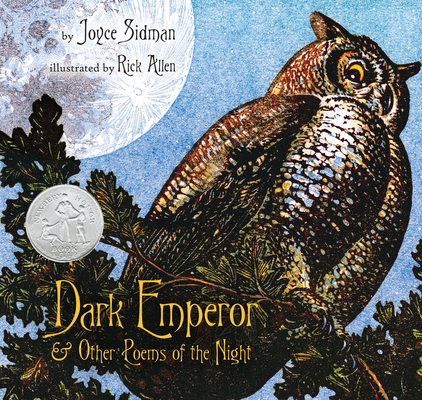
Dark Emperor and Other Poems of the Night

BIBLIOGRAPHY

            Sidman, Joyce. 2010. Dark Emperor and Other Poems of the Night. Ill. by Rick Allen. New York: Houghton Mifflin Books for Children. ISBN 978547152288

PLOT SUMMARY

In Dark Emperor and Other Poems of the Night, Joyce Sidman has written a collection of poems that describe the wonder and mystery of nighttime. The book contains a collection of 12 beautifully written poems, which inspire readers to learn more about the creatures of the night. The poems are accompanied by factual information, which provides more details about the creatures in the poems. This book is not only entertaining, but also full of educational information.

CRITICAL ANALYSIS

Dark Emperor and Other Poems of the Night is a collection of poems about the majesty of nighttime. The book opens with the poem “Welcome to the Night,” thus welcoming readers to the splendors of evening. After readers explore the various sites and sounds of nighttime, the book closes with “Moon’s Lament,” begging the question “Where has it all gone--.” 

Sidman’s poems are lyrical and have an ethereal quality. She uses a variety of rhythms and rhyme throughout the various poems, which add to the diversity of the collection. Some poems, like “Welcome to the Night,” have a discernible rhyme pattern while others like “Love Poem of the Primrose Moth” do not contain any rhyme. Her use of sound makes the poems easy to read and add to the imagery and overall effect of the poems. 

Sidman’s careful use of descriptive language makes the poems exciting and rich with details. She creates strong visuals images with the use of similes, like “where the moss grows like candy” and with unique word combinations, like “hooked face and hungry eye.” This book of poetry is well balanced, providing variations in content and style, thus keeping the reader’s interest. Each poem also includes a small lesson on the topic of the poem. For example the poem “Cricket Speaks” is accompanied by factual information about crickets.

Rick Allen’s gouache illustrations are the perfect complement to Sidman’s poems. The block-prints combined with dark colors create a shadowy effect. The details of the illustration complement the actions in the poems, but alone are still interesting and provide the opportunity for discussion.

Sidman and Allen capture the magic of night beautifully in this illustrated collection of poems. The reader experiences the sights, sounds, and smells of nighttime through Sidman’s detailed poems and Allen’s intricate pictures. This book of poetry will appeal to both young and old alike.

Dark Emperor and Other Poems of the Night provides an excellent opportunity to discuss nocturnal animals as well as fears about the dark. The factual information provided in the book is useful for helping make connections between poetry and real life.

REVIEW EXCERPTS

BOOKLIST STARRED REVIEW, 2010: “This picture book combines lyrical poetry and compelling are with science concepts.”

SCHOOL LIBRARY JOURNAL: “It invites lingering enjoyment for nature and poetry fans...”

COOPERATIVE CHILDREN’S BOOK CENTER CHOICES, 2011: “Rick Allen’s detailed, colored linoleum print illustrations lend additional beauty to this gratifying nocturnal experience.”

AWARDS

John Newbery Medal: Honor Book, 2011

Horn Book Award: Honor Book, 2011

CONNECTIONS

*Discuss nocturnal animals. Show pictures and read facts about various animals.

*Create owl masks and ask children to read “Dark Emperor” aloud. Good instructions for creating a mask are located here: http://www.sproutonline.com/crafts-and-recipes/crafts/owl-mask

*Turn off the lights and listen to a disc of night sounds. Ask children to discuss all of the things they hear.

Friday, March 2, 2012

Flamingos on the Roof

 
BIBLIOGRAPHY

            Brown, Calef. 2006. Flamingos on the Roof. Ill. by Calef Brown. Boston: Houghton Mifflin Company. ISBN 9780618562985

PLOT SUMMARY

In Calef Brown's wacky collection of poems, Flamingos on the Roof, anything goes. From a diner that serves weather to a soppy circus, readers experience all of the silliness in Brown's zany world. The absurd rhymes and colorful illustrations are sure to make this collection of poems a favorite with children.

CRITICAL ANALYSIS

The poems in Flamingos on the Roof are written in meter and all include a rhyming element, which is sure to be popular with young children. The poems in the collection are silly and nonsensical, so the rhythm fits harmoniously with the content. Some of the poems are much better than others. “Weatherbee's Diner” is an excellent example of Brown's effortless poetry; however, the poem “Bob” is more forced and does not roll of the tongue quite as easily. Brown uses a variety of sound devices throughout his poems, which gives them a sing-song effect. The poem “Peas,” includes lines like “peas peek out of the pod, which illustrates Brown's brilliant use of alliteration. While poems like “Combo Tango,” illustrate his whimsical use of assonance.

Flamingos on the Roof does not appear to be arranged in any discernible order, which fits with the overall whimsy of the collection. Brown's poems are preposterous and full of surprises, which add to their charm and appeal. His brilliant use of personification, like in the poem “Bug Show” allows him to use a host of characters and create unique and exciting images. In the poem “Barnacle Built for Two,” Brown paints a vivid image of two barnacles on the side of a ship, with lines like “Stuck on the hull of a sailing ship / with powerful barnacle glue.”

Brown's full-page, acrylic illustrations are child-like and flawlessly capture the sentiments of each poem. The font used for the text adds to the fun and charm of the collection. This poetry book is an excellent read-aloud for school-age children. Children will delight at both the humorous poetry and the big, bold illustrations.

REVIEW EXCERPTS

KIRKUS REVIEW, 2006: “Composed with a fine ear for consistent rhythms and silly wordplay, these verses will tempt readers into repeat visits, or as the poet puts it: ‘Swivel on your kneecap. / Wobble like a mud flap. / Take a little catnap. / Do it all again!’”

SCHOOL LIBRARY JOURNAL BOOK REVIEW, 2007: “Packed with amusing details, the paintings consistently expand upon the text. Read aloud, these poems are sure to delight listeners.”

LIBRARY MEDIA CONNECTION, 2007: “This book would be a great addition to any school library to encourage the love of poetry.”

AWARDS

Myra Cohn Livingston Award for Poetry: Winner, 2007

CONNECTIONS

*Split children up into two groups and have each group read one section of “The Appleton Twins.” Students should be encouraged to use inflection and sound effects to emphasize the differences in the twin voices.

*Read one the longer poems like “Soggy Circus” or “A Camping Tale” and then ask children to create an image to illustrate the poem. Show the illustration in the book after the children have completed their interpretations.

*Discuss Haiku poetry and encourage children to write a Haiku poem after reading “Ten-cent Haiku.”

*Read other whimsical poetry collections and have a discussion about favorite poems and poets. Some possible collections include:
·         Runny Babbit: A Billy Sook by Shel Silverstein
·         It's Raining Pigs and Noodles by Jack Prelutsky
·         Dirt on My Shirt by Jeff Foxworthy and Steve Bjorkman

Thursday, March 1, 2012

One of Those Hideous Books Where the Mother Dies

BIBLIOGRAPHY

Sones Sonya. 2004. One of Those Hideous Books Where the Mother Dies. New York: Simon & Schuster Books for Young Readers. ISBN 9780689858208
PLOT SUMMARY
In Sonya Sones verse novel One of Those Hideous Books Where the Mother Dies, we meet 15-year-old Ruby Milliken. Ruby is devastated by the death of her mother and to make matters worse she must say goodbye to her best friend and amazing boyfriend. She is forced to move across the country to live with her movie star dad, whom she's never met. Ruby is furious that her mother's dead and now she must go live with the man that abandoned her before she was ever born. However, Ruby soon learns that things are not always as they seem and that everyone deserves a second chance.


CRITICAL ANALYSIS

In One of Those Hideous Books Where the Mother Dies, Sonya Sones flawlessly captures the voice of 15-year-old Ruby Milliken. Sones' novel is written in blank verse poetry, so the length and complexity of each poem varies throughout the novel. However, Sones use of imagery weaves around 200 separate poems into an emotional and well-crafted novel. Although the novel is meant to be read in its entirety, the rhythm of the poems lend themselves to being read aloud, individually.

Separately, the poems are emotional, but combined the poems are compelling. The whole collection must be read in order to fully appreciate the emotional impact of the poems. The poem “We flip to the next page,” details a profound moment in which Ruby finds out that her absentee father has always longed for a relationship with her. The poem is full of  revelations; however, the impact of the poem is reduced when it is not read in the context of the novel.

This book will appeal to young adults because the poems are written from the perspective of a 15-year-old girl. The references to current movie stars and fashion trends along with the use of slang terms provides a modern appeal. The language Sones uses in the poems resonates with the target, young adult, audience. In the verse “I don't know why they call it Lakewood,” Sones illustrates what it's like being at a new school and trying to fit in. Lines like “I can feel a huge zit / blooming on the tip of my nose. / It's flashing on and off like a neon sign,” brilliantly capture the insecurities of adolescent youth.


One of Those Hideous Books Where the Mother Dies creates a good opportunity to discuss grief and the life changes that young adults experience. The book also provides an excellent opportunity to discuss various types of poetry.

REVIEW EXCERPTS

BOOKLIST STARRED REVIEW, 2004: “A satisfying, moving novel that will be a winner for both eager and reluctant readers.”
KLIATT REVIEW, 2004: “Exceptional book, recommended for junior and senior high school students.”
THE ALAN REVIEW, 2005: “Young readers will be drawn to the journalistic feel, poetic set-up, and page-long chapters.”

AWARDS
  • Society of School Librarians International Book Awards: Honor Book, 2004
  • YALSA Best Books for Young Adults: 2005
  • John and Patricia Beatty Award: Finalist, 2005
CONNECTIONS
  • Ask students to select their favorite poem and read it aloud. Then, discuss how this type of novel differs from a traditional novel.
  • Discuss dream interpretation and share some books about Freudian and Gestalt theory.
  • Ask students to share their experiences with other verse novels. Share a list of other novels in verse, including:
    • What My Mother Doesn't Know by Sonya Sones
    • Make Lemonade by Virginia Euwer Wolff
    • God Went to Beauty School by Cynthia Rylant
    • Street Love by Walter Dean Meyers

Tuesday, February 14, 2012

Boots and His Brothers: A Norwegian Tale


BIBLIOGRAPHY
Kimmel, Eric. 1992. Boots and His Brothers: A Norwegian Tale Retold. Ill. by Kimberly Bulcken Root. New York: Holiday House. ISBN 0823408868

PLOT SUMMARY

In Boots and His Brothers, three brothers, Peter, Paul, and Boots, set out on a journey to make their fortune. When they meet an old beggar woman, she tells the brothers of a kingdom “three days’ journey away,” where they can make their fortune. Peter and Paul are rude an ungrateful for the information and refuse the woman’s request for money. Boots is kind to the woman and in turn she gives him some valuable advice. Boots uses the advice to capture the fortune, while his brothers are met with grave consequences.

CRITICAL ANALYSIS

Boots and His Brothers maintains the integrity of early retellings, yet is in Kimmel’s unique voice. The story is lengthy, so it is best suited to older children. However, the story’s elements of suspense and magic will keep children interested until the very end. Although the book is based on a Norwegian folktale, Kimmel’s retelling does not include specific elements that are indicative of the Norwegian culture.
The global message of the story, good triumphs over evil, is obvious. The disrespectful brothers are punished for their bad behavior, while the kind and moral Boots is rewarded for his obedience. Children will be captivated by the beggar woman’s mysterious advice and the story’s magic motif.
Although Boots and His Brothers is an entertaining story, Bulcken Root’s illustrations do not complement Kimmel’s text. The illustrations are too dark and the details are obscured, so in many instances it is unclear what is being depicted. Therefore, children are not able to interpret the story simply by looking at the pictures. The overall style of the illustrations fits with the story, but the dark colors and lack of details make the images unappealing. Also, the size and layout of the illustrations interrupt the flow of the story. Full-page illustrations with more detail would make the story more compelling and appealing. Basically, the illustrations do not provide the necessary details to adequately represent the story.
The overall theme of Boots and His Brothers is that kindness is rewarded. This story shows children that it is beneficial to listen and follow directions.
MY THOUGHTS
Boots and His Brothers is an entertaining story with a positive message, but the unappealing illustrations do not make this an engaging read aloud. The illustrations detract from the story because it is hard to tell what is being depicted.
This is definitely not one of my favorite picture books. By definition, a picture book should have good pictures, which help tell the story. Boots and His Brothers suffers from poor illustrations, thus the overall appeal is affected.
REVIEW EXCERPTS

KIRKUS STARRED REVIEW, 1992: “Well crafted by all concerned, a fine addition.”

BOOKLIST REVIEW, 1994: “With a combination of plainness and magic, the story is well paced and dramatic, told in simple rhythmic prose.”

PUBLISHERS WEEKLY, 1992: “It is this idiosyncratic artwork that will most engage the reader.”

AWARDS

N/A
CONNECTIONS

  • Have a discussion about helping those in need. Ask children if they have ever done anything to help someone in need?
  • Read other Norwegian tales and discuss their similarities. Some stories include:
    • The Three Billy Goats Gruff by Paul Galdone
    • Seven Fathers by Ashley Ramsolen
    • Town Mouse, Country Mouse by Jan Brett
    • Trouble with Trolls by Jan Brett
  • Discuss the Norwegian culture and show children a map of Norwegian countries.